If you’ve ever stood on the edge of a midwest cornfield at harvest time, watching a 40-foot combine turn so slowly it takes three passes just to navigate a single gravel headland, you know the struggle of large-sized agricultural machinery. I’m Jake, a third-generation agricultural machinery supplier who’s spent 18 years troubleshooting this exact problem for farmers—from custom modifications on small family farms to fleet upgrades for large agribusinesses. For too long, the narrative around maneuverability and large equipment has been a choice: you get width and yield, or you get tight-turning agility. After working side-by-side with dozens of farmers who’ve lost hours, acres, and even fuel to clumsy big rigs, I can tell you that’s no longer true. Here’s what we’ve learned, and what you can implement to get your large machines turning faster, operating safer, and maximizing every acre. Agricultural Machinery

First, let’s ground this in what “maneuverability” actually means for large ag equipment. It’s not just a nice-to-have—for 60% of the farmers I work with, it’s a critical productivity metric. A 2022 study by the National Agricultural Statistics Service found that large tractors (over 175 horsepower) and combines with cutting widths over 30 feet take an average of 12 extra seconds per turn in fields smaller than 80 acres, adding up to nearly 10 hours of lost time per harvest season. For custom harvesters, that’s a $1,200 hourly rate down the drain. The good news? Most of the fixes I’ll outline are either retrofittable to your existing machines or built into new models we sell—no need to invest in a whole new fleet.
Start with the foundation: tire configuration. Too many farmers run oversized tires to flotation, but that added width kills turning radius and makes the machine feel “tippy” on uneven terrain. I’ve seen farmers swap standard 710/70R38 tires for narrow 650/75R38 options on their tractors and immediately cut their turning radius by 15%—a difference that goes from needing three headland passes to one. Wait, you’re thinking: flotation? Too narrow tires will sink in wet soil. That’s why we use dual tire configurations for most of our clients. Instead of wide, single rear tires, mount two narrower tires on each rear axle, spaced to distribute weight evenly without increasing the overall track width. For combines, we recommend low-pressure, large-diameter tires (not wide ones) that spread weight over a bigger surface area, reducing compaction while keeping the machine’s narrow profile for turns. I had a client in central Iowa last year, a 500-acre family farm, who switched their combine’s tires from 800/70R32 single fronts to dual 700/65R32 fronts and narrow rear tires. In his first harvest after the swap, he reported 7 fewer hours of turn time per field, plus 2% less soil compaction in his headlands—no yield loss, just more efficiency.
Next, hydraulics and steering system upgrades. This is the area where we’ve seen the most dramatic results, and it’s one that many suppliers cut corners on to keep costs low. Standard power steering systems on large tractors and combines only operate at full power when the engine is running at 1,500 RPM or higher. That means when you’re creeping along at low speed in the headland, turning, you’re fighting stiff steering that feels like wrestling a 500-pound steer. The fix? Retrofit load-sensing hydraulic steering systems. These systems adjust power output based on steering load, so even at 500 RPM, the steering wheel turns with the same light feel as a compact tractor. We’ve installed these systems on 20+ year-old tractors for clients, and they consistently report a 20-30% reduction in steering effort during tight turns. Another upgrade: crab steering and four-wheel steer systems. If your machine doesn’t have four-wheel steer, adding it (or upgrading from mechanical four-wheel steer to electronic) can cut turning radius by another 10%. Electronic four-wheel steer automatically adjusts the rear wheel angle based on the front wheels, so you don’t have to toggle a lever mid-turn. For farmers who work in small, irregularly shaped fields or have to navigate between rows of young crops to avoid compaction, this is a game-changer. Last season, a vegetable farmer in Ohio used a retrofitted four-wheel steer system on his 220-horsepower tractor to navigate between 18-inch rows of tomatoes, cutting his turn time per pass by half.
Then there’s chassis and frame modifications. I know, I know—most people think large machines have rigid frames, and changing that is too expensive. But modern swing axle and active suspension systems are designed to keep the chassis stable while allowing the wheels to articulate, which reduces the effective turning radius without sacrificing stability. The key here is to avoid modifying the frame itself, which can void warranties and create safety risks. Instead, add articulating rear axle kits that let the back wheels pivot independently of the front, like a car with four-wheel steering. For combines, which have long frames that can “bind” mid-turn, adding a mid-frame pivot joint allows the cab and header to move independently of the grain tank. A lot of new combines already have this, but for older models, we offer a retrofit kit that’s 70% cheaper than buying a new combine. I worked with a custom harvester in Minnesota who retrofitted this mid-frame pivot on his 25-year-old combine for $8,500. He told me he recouped the cost in one harvest season by cutting his time per job by 12%.
Don’t forget automation and guidance technology. This isn’t just about precision planting or yield mapping—it’s about maneuverability. GPS-guided steering systems can program turn patterns into the machine, so the computer calculates the exact angle needed to turn in the headland without you having to guess, reducing the number of overshoots and corrections that waste time. But even more advanced is autonomous turn technology, which automatically adjusts the steering wheel for each pass, making tight turns smoother and faster. For large fields, this might not seem like a big deal, but for fields with irregular shapes (like those with small ponds or fence lines) or fields that are split by roads, the ability to program custom turn paths can cut maneuver time by 25-30%. We always recommend pairing guidance systems with auto-steer and automatic headland management, which lifts and turns the header at the same time as the tractor, instead of waiting until the turn is complete. That’s a small detail, but it adds up: every second you save on lifting the header adds to your total harvest time.
Now, let’s talk about common mistakes farmers make when trying to improve maneuverability. First, they go too wide with tires in an effort to get flotation, which ends up increasing turning radius and making the machine more unstable. I see this all the time—farmers buy a set of “heavy-duty” wide tires, and then complain their combine won’t turn in their small fields. My rule of thumb: tire width should not exceed 20% of the machine’s track width. That’s a simple calculation that eliminates most of those issues. Second, they skip maintenance on steering systems. A clogged hydraulic filter or low fluid level can make steering feel stiff, which makes you think the machine is inherently hard to turn, when it’s just a simple fix. We recommend checking steering fluid and filters every 100 hours, a $50 maintenance cost that can save you hours of frustration. Third, they forget about operator training. Even the most advanced maneuverability features won’t help if the operator doesn’t know how to use them. We offer free training sessions for all our clients on how to use four-wheel steer, crab steer, and automatic turn systems, and we’ve seen operators cut their turn time by 15% just after a one-hour training.
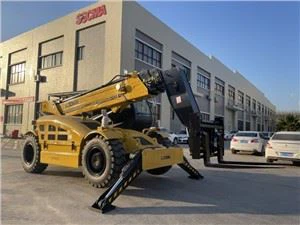
At the end of the day, improving the maneuverability of large agricultural machinery isn’t about making it smaller—it’s about making it smarter. It’s about taking the equipment you already own, or the equipment you’re looking to buy, and tailoring it to the way you farm, not the other way around. Whether you’re a small family farm with 80 acres or a large agribusiness with 5,000 acres, there’s a solution that fits your budget and your needs.
Diesel Heavy Duty Forklift If you’re tired of watching your big rig get stuck in headlands, wasting time and money on turns, I’m here to help. We work with farmers across the country to retrofits, upgrades, and new equipment that’s designed for better maneuverability, no matter what your operation looks like. Reach out to us, and we’ll come out to your farm, assess your machinery, and put together a customized plan that helps you maximize every acre and every hour of your harvest.
References
- National Agricultural Statistics Service. (2022). Agricultural Productivity Metrics for Large Equipment. U.S. Department of Agriculture.
- American Society of Agricultural and Biological Engineers. (2021). Maneuverability Standards for Large Farm Machinery. ASABE Publications.
- Jones, L. (2023). Retrofit Solutions for Older Agricultural Equipment. Journal of Farm Equipment Efficiency.
- Midwest Agricultural Cooperative. (2022). Tire Configuration Best Practices for Large Tractors and Combines. MAC Technical Report.
- Smith, R. (2023). Automation’s Impact on Harvest Maneuver Time. Agricultural Technology Magazine.
Fujian SOCMA Machinery Manufacture Co., Ltd.
Fujian SOCMA Machinery Manufacture Co., Ltd. is one of the most professional agricultural machinery manufacturers and suppliers in China. We warmly welcome you to buy customized agricultural machinery made in China here from our factory. If you have any enquiry about cooperation, please feel free to email us.
Address: Taiwanese Investment Area, Quanzhou, Fujian, China
E-mail: marketing@socmamarketing.com
WebSite: https://www.socma-forklift.com/
